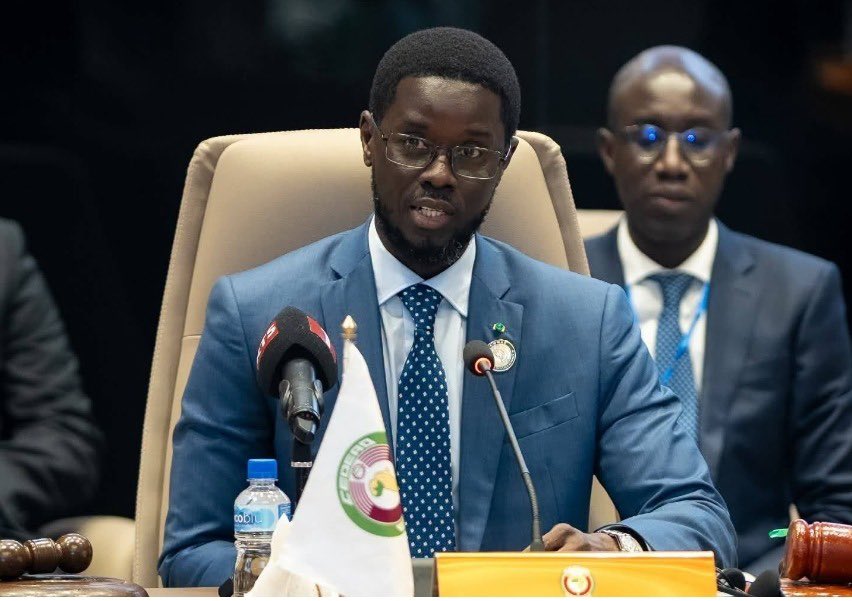
Senegalese President Bassirou Diomaye Faye has been elected Chairman of the Economic Community of West African States (ECOWAS), succeeding Sierra Leone’s President Julius Maada Bio. His election comes at a critical period as the regional bloc faces security concerns, political divisions and renewed calls for stronger economic integration.
The 46-year-old leader will serve as chairman for one year, becoming one of the youngest presidents to head the West African regional organisation.
From tax inspector to president
Before entering politics, Faye worked as a tax inspector in Senegal’s civil service. He later became active in politics through the PASTEF party, where he gained recognition as a close ally of Ousmane Sonko.
His political journey took an unexpected turn when Sonko was barred from contesting the 2024 presidential election, paving the way for Faye to emerge as the party’s candidate.
He became president after leaving prison
One of the most remarkable aspects of Faye’s political career is that he won Senegal’s presidency shortly after regaining his freedom.
He had been detained on political charges before the 2024 election and was released only days before the polls. Despite the circumstances, he secured victory in the first round and was sworn in as Senegal’s president on April 2, 2024.
One of Africa’s youngest leaders
Born on March 25, 1980, Faye became one of Africa’s youngest serving presidents after taking office at the age of 44.
His emergence has been viewed by many observers as a sign of a new generation of political leadership gradually taking centre stage across the continent.
His administration is built on reform promises
Since assuming office, Faye has focused on governance reforms, anti-corruption measures and strengthening state institutions.
He has also pushed for greater economic sovereignty and a review of some agreements involving Senegal’s natural resources, arguing that the country’s wealth should deliver greater benefits to its citizens.
He takes over ECOWAS at a challenging time
Faye’s election comes as ECOWAS faces one of the most difficult periods in its history.
The exit of Mali, Burkina Faso and Niger from the regional bloc has tested regional unity, while insecurity, terrorism and political instability continue to threaten parts of West Africa.
His leadership will be closely watched as member states seek ways to restore confidence in the organisation and strengthen cooperation across the region.
Economic integration remains a priority
Beyond politics and security, ECOWAS is also focused on improving trade and regional infrastructure.
At the summit in Freetown, leaders discussed projects including the Nigeria-Morocco Atlantic Gas Pipeline, which is expected to improve energy access and economic cooperation across West Africa.
Faye is expected to play a leading role in advancing initiatives that promote regional integration and sustainable economic growth.
What his emergence means
Although the ECOWAS chairmanship rotates annually, the office carries considerable diplomatic influence. As chairman, Faye will coordinate engagements among member states and help shape the bloc’s response to regional political, economic and security challenges.
His rapid rise from a civil servant to Senegal’s president and now Chairman of ECOWAS has made him one of the continent’s most closely watched political leaders. How he navigates the complex challenges facing West Africa will likely define both his tenure and the future direction of the regional bloc.